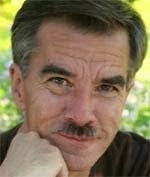
Following the war, Walter seized an unexpected opportunity to move from the VOA's Austrian Service to the State Department's EUR Bureau. Returning as a U.S. official to his birthplace in order to launch a public diplomacy program was an invigorating yet bittersweet experience.
…As early as the Paris Conference of 1947, I think, it was
decided by the four Powers – now France was included – to achieve an Austrian
treaty. And each of the four
powers appointed a deputy for Austria.
Most of these meetings took place in London. They led nowhere because of the famous “nyet” of our Russian
colleagues. In 1948, the foreign
ministers met at the General Assembly session of the United Nations in New
York, and the Americans and the British and the French asked -- I think it was
Vyshinsky at the time – “What about an Austrian treaty?” And he said, well, we have to have
this, this, this and this. Which
were enormous burdens on Austria.
Austria had oil wells in the eastern part, which the Russians exploited.
But it was decided that the Austrian deputies of the four Powers
meet at the Waldorf Astoria Hotel in September of 1949, and Foy Kohler sent me,
because I served on the Austrian desk, to be the VOA correspondent at these
Austrian treaty talks.
There was
the deputy for Austria, a high-ranking Foreign Service officer with the name of
Samuel Reber, who one day said: “Why don’t we have a cup of coffee?” And he and I had a cup of coffee, and he said to me: “What’s your future, Walter?” I said, ‘Well, doing my job at
the Voice of America.” He said, “I
have a feeling you can do more than that.
I would like you to meet a friend of mine who is Deputy Assistant Secretary
for European Affairs with the name of Llewellyn Thompson. I’d like to arrange a meeting. Is that alright with you?” I said: “Well, wonderful, thank you.” So the meeting was arranged, I went to Washington from New
York. Tommy Thompson couldn’t have
been nicer. In the middle of the
conversation, he goes to his desk, pulls out a chart, and that was the
organizational chart of the Department of State. He puts it in front of me and says: “Which job would you like to
have?” And I said, “Mr. Secretary,
all I want is to work on the Austrian desk.” He said:
“Well, let’s see whether this can be arranged.” Three months later, Martin Herz, who
was very well known in the Department, got an assignment as political officer
in Paris. The job came open, and I
was asked whether I would come to Washington. Indeed, it was an internal transfer, because people who
worked in the Voice of America were State Department employees since 1945. So for me it was basically a transfer
from New York to Washington, and I came to the Austrian desk in the spring of
1950.
 |
| Samuel Reber |
 |
| Wiener Kurier, 1945 |
What happened was that the four Powers had decided to change
their arrangements in Austria, as they did in Germany in ‘49. The principal officer of each country
was a high commissioner. After
1950, it was an American general, in charge of American troops in Austria; he
was the high commissioner. There
was an American legation, not an embassy, which had certain functions, limited. But it was decided to put these two
together, and put them under civilian control. And I was asked to establish a USIS program, the way we had
it in France or in Spain. Public
affairs officer, information officer, cultural officer etcetera and so forth. I was absolutely amazed at the size of
the program. The Army was in
charge. For them, information and
cultural and press programs were minor expenditures. I remember when I became deputy area director for Europe
when USIA was created in 1953, the program in Austria still at that time was $7
million a year. I always loved to
say we spent one dollar on every Austrian. Whereas the
program in France was $280,000.
That was the ordinary State Department/USIS program. They were not large. Germany and /Austria had extremely
large programs. I think the table
of organization that I left when I came back to Washington was 50 or so
people.
Now, we ran a newspaper in
Vienna, the Wiener Kurier. We ran a three radio station
network, Red-White-Red. Surely,
there was more money because of these factors. But it was a great program, and I must say, in fairness, the
Army people that ran the program from ’45 to ’50 did a very adequate job.
 |
| Red-White-Red poster, 1954 |
Those two media I just mentioned, Red-White-Red -- we had a
very strong radio station in Vienna which of course covered the Soviet zone and
the Soviet sector of Vienna. And
we had a newspaper, which, while often in difficulty in the Soviet zone, was
distributed. So our main purpose
was to quiet and perhaps nullify the influence of the Soviet information media upon
the Austrians. But we had a
feeling we were winning this war, handily. Austrians did not like the Russians, oh no.
…I will tell you that when I try to explain to my American
friends or others the atmosphere in Vienna – I went back the first time in
1947, then again in ‘48 and ‘49 and then on this assignment in 1950 – was
extremely well presented in “The Third Man.” This was not a propaganda film. This is what Vienna looked like, how the Viennese behaved,
it is a remarkably good job, “The Third Man.” The Austrians themselves were very much aware of the
background and the role that they played as German citizens. There were Austrians who reached the
upper level of the Nazi party.
Some of the commanders of the concentration camps were Austrians. It was not easy for some of the
Austrians to talk to people like me.
They felt full of guilt, yet also wanted to explain. There are different emotions.
I think I can say – and I think my
friends will confirm this – that I went about it as objectively as one
can. I tell you very frankly my
wife would not. I, for instance, would never have
accepted, although it was offered me, a job as public affairs officer in
Vienna, particularly in those early days, because I don’t think my wife could
have been objective.
 |
| Vienna Street Scene from Carol Reed's "The Third Man" |


 Posts
Posts